






Home / Sunday-mid-day / / Article /
Strength in numbers
Updated On: 05 May, 2024 07:50 AM IST | Mumbai | Shweta Shiware
Will Mumbai and 29 lakh SEWA sisters get a chance to visit a seminal show? The Hum Sab Ek exhibit, compiled from oral histories and surveys of 1,000 homes, maps the practical, expedient, and mutually beneficial solutions devised by India’s largest trade union of self-employed women to overcome COVID

Listen to this article :
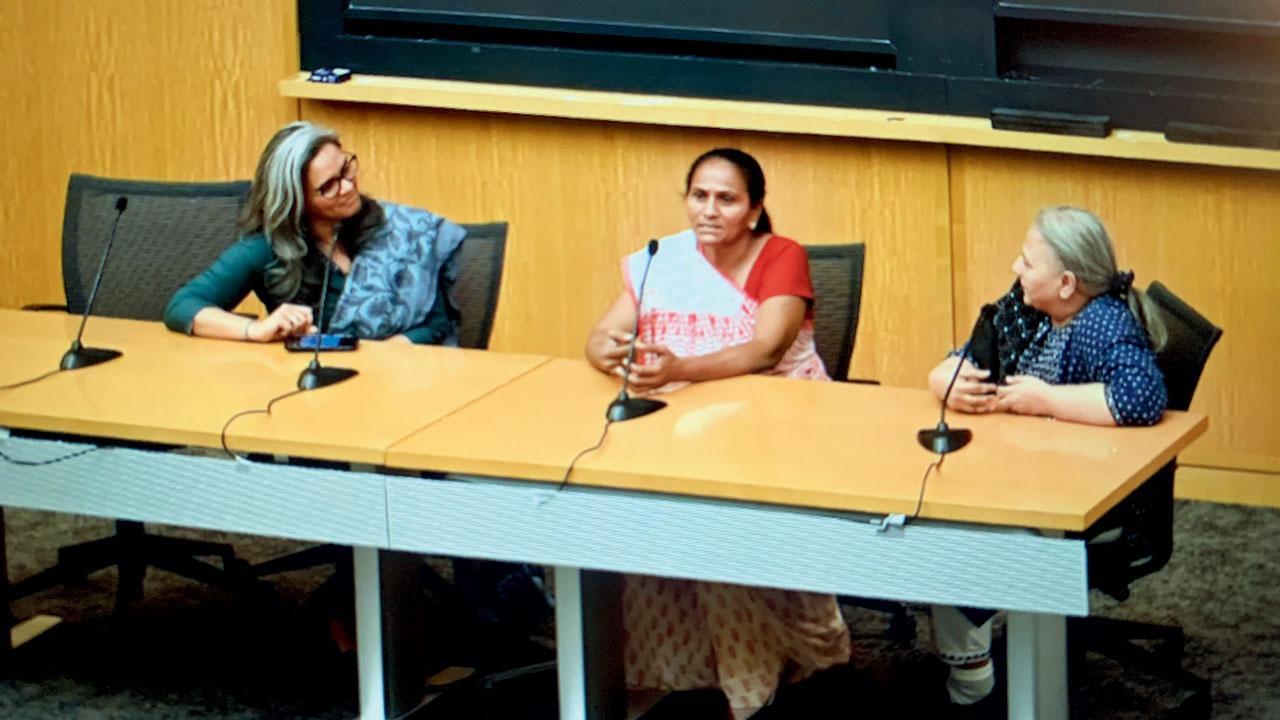
Former SEWA president Kapilaben Bhailalbhai Vankar delivered an uninterrupted 35-minute speech during the opening reception of Hum Sab Ek exhibition at the Tsai Auditorium, part of the Lakshmi Mittal and Family South Asia Institute on Harvard’s Center for Government and International Studies South (CGIS South) campus in Cambridge, on April 15. SEWA director Reemaben Nanavaty (right), translating for her, requested Kapilaben to slow down, as it was difficult to accurately convey every detail of her impassioned delivery. Sarita Gupta, vice president-US Programmes at Ford Foundation, was also present
Namaste, I am Kapilaben from Rasmol village, Anand District, Gujarat,” greeted a beaming face from my laptop screen. The vibrant cyan wall behind Kapilaben Bhailalbhai Vankar, 54, during the video interview was in stark contrast to the venue she occupied on April 15, with its acoustic wood panels and AV screen. On that day, at the opening reception of Hum Sab Ek multimedia exhibition, Kapilaben—formerly the president at the Self Employed Women’s Association (SEWA)—engaged in a panel discussion with Reema Nanavaty, SEWA’s director, and Sarita Gupta, vice president-US Programmes at Ford Foundation, her firebrand voice deeply resonating with the audience.
Draped in a hand-block printed khadi saree, Kapilaben delivered a 35-minute speech to an audience of academicians, medical practitioners, and Harvard graduate students at the Tsai Auditorium in the Center for Government and International Studies South (CGIS South), part of the Lakshmi Mittal and Family South Asia Institute on Harvard campus in Cambridge. “I was so engrossed in sharing stories about my sisters, I lost track of time,” she laughs. “For me, SEWA is not an organisation; it is a sisterhood.”
Read Next Story
Trending Stories
Latest Photos
Latest Videos
Latest Web Stories
ADVERTISEMENT
Mid-Day Fast
ADVERTISEMENT

ADVERTISEMENT