






Home / Sunday-mid-day / / Article /
Exclusive: Ex-ISRO chief K Sivan is confident about Chandrayaan 3's success
Updated On: 16 July, 2023 11:07 AM IST | Mumbai | Aastha Atray Banan
It will be a while before Chandrayaan-3 reaches the moon. If you are anxious, don’t be. At ISRO, as ex-chairman K Sivan tells us, the hours leading up to the launch or the time spent after, are always about solution finding, and not worrying

Listen to this article :
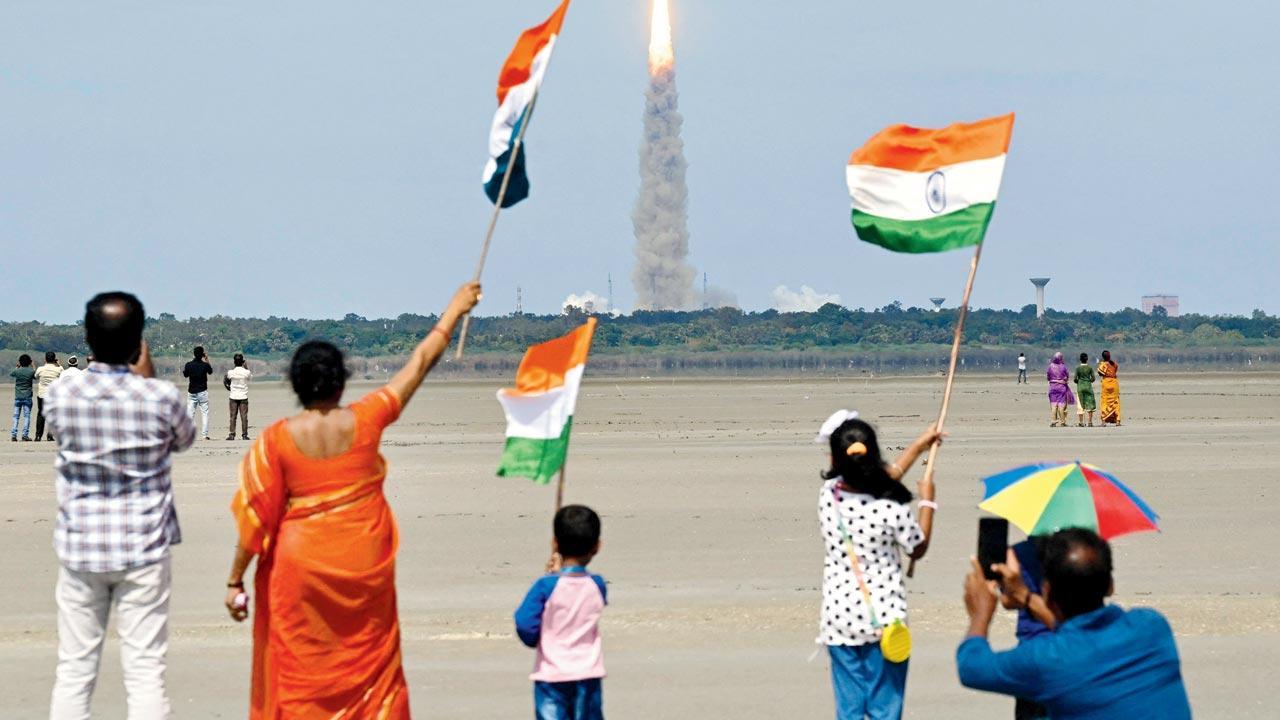
People wave Indian flags as Chandrayaan-3 lifts off from the Satish Dhawan Space Centre in Sriharikota, an island off the coast of Andhra Pradesh, on Friday. Pic/Getty Images
Minutes before the Chandrayaan-3 launched from Sriharikota in Andhra Pradesh on July 14, the Indian Space Research Organisation’s chairman S Somanath was seen watching intently, almost appearing stressed. But, “this is nothing special for ISRO—it’s like any other launch or test,” Dr K Sivan assures us. When he served as the ISRO chairman from 2018 to 2022, Sivan was in charge of the ill-fated Chandrayaan 2 mission that launched on July 22, 2019—its lander crashed when it deviated from its intended trajectory while attempting to land, on the moon on September 6. A failure analysis report submitted to ISRO attributed the crash to a software glitch.
Chandrayaan-3 will be inserted into the Lunar Transfer Trajectory after orbit raising manoeuvre. It will cover a distance of over 3,00,000 km and is expected to reach the Moon in 40 days, roughly around August 23. It is equipped with a lander, a rover and a propulsion module. Upon landing, it will operate for one lunar day, approximately 14 Earth days, and will study our satellite’s surface.
Trending Stories
Latest Photos
Latest Videos
Latest Web Stories
ADVERTISEMENT
Mid-Day Fast
ADVERTISEMENT

ADVERTISEMENT