






Home / Sunday-mid-day / / Article /
Buddhist art of the Deccan to get recognition at New York’s Met
Updated On: 16 July, 2023 09:19 AM IST | Mumbai | Sucheta Chakraborty
A grand exhibition that opens at New York’s Met celebrates ignored Buddhist art of the south, including Maharashtra, shining light on the piece that completes the Indo-Roman trade story

Listen to this article :
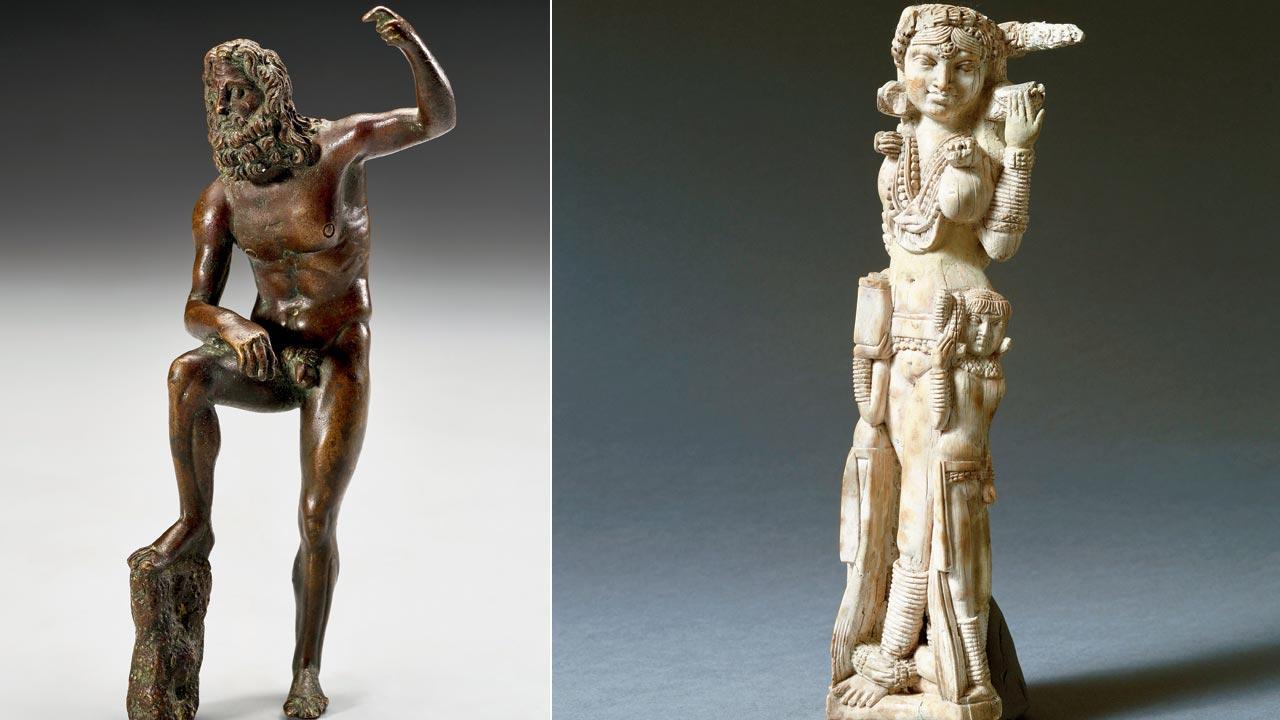
Poseidon (after Lysippos), Alexandrian Roman, 1st century CE, copper alloy, 57/8 × 115/16 × 115/16 in. (15 × 5 × 5 cm), excavated at Brahmapuri in Kolhapur of Satara district, Maharashtra, 1944–45, collection: Town Hall Museum, Kolhapur, Maharashtra; (right) An ivory statuette discovered in the ruins of Pompeii, a Roman city destroyed in the eruption of Mount Vesuvius 79 CE. It was found by Italian scholar Amedeo Maiuri. The yakshi or tree spirit representing fertility is evidence of commercial trade between India and Rome in the first century CE. According to the Naples National Archaeological Museum, it was created in India in the first half of that century. Pic/Getty Images
The understanding of Buddhism as we see it today is a 19th century reinvention, largely premised on scholars who were studying the texts and the core of Buddhist literature—the sutras, jatakas, avadanas—in the abstract as purely religious documents. This, in a sense, detached the understanding of Buddhism from the reality on the ground. They were also focused on the holy sites of the Buddha, i.e., those touched by his presence in his lifetime, from his birth through to his paranirvana or “complete extinction” and therefore, became pilgrimage sites. All of those are located in North India,” John Guy, Florence and Herbert Irving Curator of the Arts of South and Southeast Asia, Department of Asian Art, The Metropolitan Museum of Art (Met), New York, tells mid-day over a video call.
Guy is the curator of Tree and Serpent: Early Buddhist Art in India, 200 BCE—400 CE, an exhibition opening at the Met this week, featuring more than 125 objects, including major loans from India, which gives long due recognition to the lesser-known Buddhist art of the Deccan. “I felt it was important to look at the most important surviving intact monuments we have for all early Buddhism. There is Bharhut, Sanchi, the early phase Ajanta, and early phase Amaravati. These are the four greatest surviving monuments we have of early Buddhism in India and they’re all in the South. Nothing approaching them survives in the north, except Sarnath, most of which has been subjected to extensive renovation. And because Buddhism today, has become a global religion, people almost lose its connection with India sometimes. But of course, it is born in India. It is an Indian religion. It originated and was nurtured in India. I wanted to bring that point home very strongly,” he says.
Trending Stories
Latest Photos
Latest Videos
Latest Web Stories
ADVERTISEMENT
Mid-Day Fast
ADVERTISEMENT

ADVERTISEMENT