






Home / Sunday-mid-day / / Article /
The language of Dalit food
Updated On: 16 June, 2024 08:50 AM IST | Mumbai | Sucheta Chakraborty
The English translation of a prominent work on Dalit food practices adds new questions about the specificity of Dalit experiences and the visualising of marginality through mainstream languages to the issue of food politics

Listen to this article :
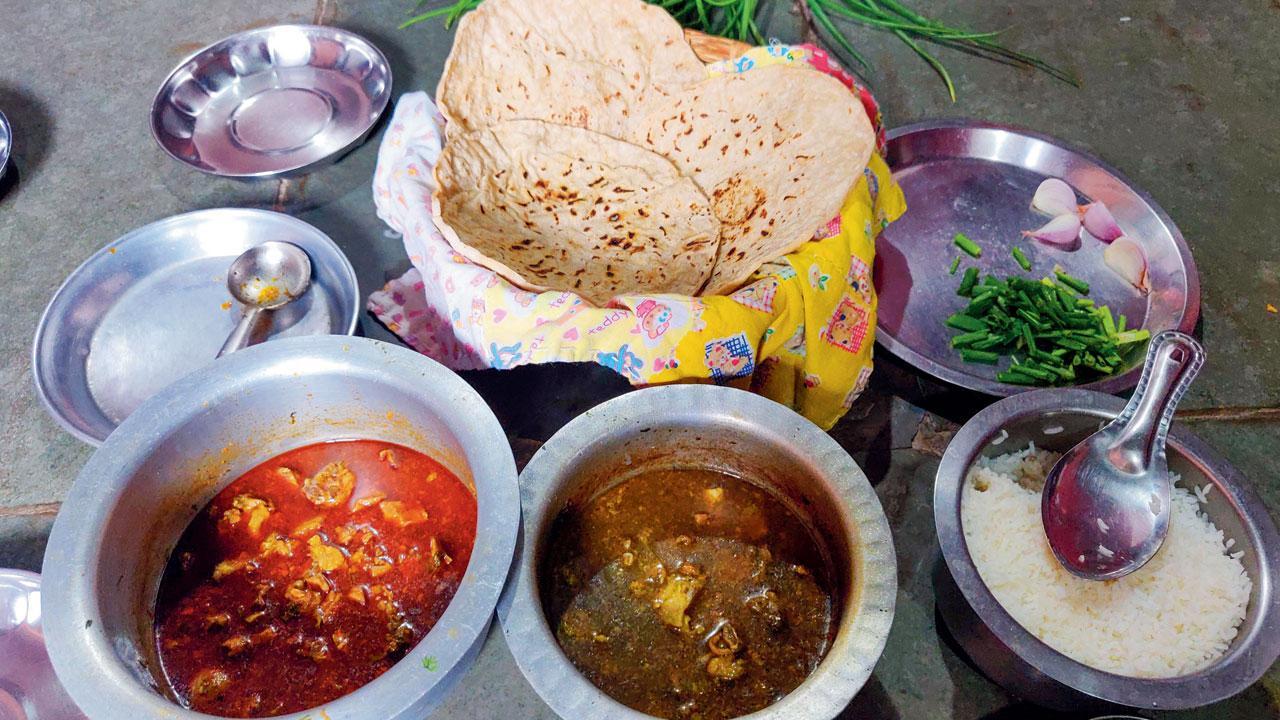
Dalit Kitchens of Marathwada has a certain freewheeling quality where recipes appear in between stories and descriptions of rituals. Barbat and alani mutton curries were two items that the author’s mother had prepared for the translator when the latter went to visit them. PIC/KUNAL VIJAYAKAR
"A lot of the Marathi words we use in the village can’t be found in a Marathi dictionary,” writer Shahu Patole tells us over a phone call. Words like ‘boti’ (small pieces of meat), ‘chaani’ (dried meat chunks) or ‘lakuti’ (animal blood preparation) are concepts, he says, whose contexts need to be understood. Hence when in May 2021, Bhushan Korgaonkar was brought in to work on an English translation of Patole’s 2015 Marathi publication, the Mumbai-based director and theatre producer travelled to Patole’s village in Osmanabad to familiarise himself with this region- and community-specific vocabulary about farming and cooking, and get acquainted with the agricultural equipment, vegetables and animal parts that featured in its food practices. Patole’s original work titled Anna He Apoorna Brahma, which was the first book to document Dalit food history through the culinary traditions of the Maharashtrian Mahar (the Mahars became neo-Buddhists in 1956) and Mang communities, is about 230 pages long. The new English translation, Dalit Kitchens of Marathwada (HarperCollins India), due to the elucidations and an extensive glossary, is more than a hundred pages longer.

Ukhal, a large and heavy mortar carved out of a monolithic stone used for grinding dry items like chutney powders, dried chillies and salt crystals. A stone or iron pestle is used to pound things in it. A piece of cloth is always left in the ukhal to keep dust and insects away and clean it before every use
Read Next Story
Trending Stories
Latest Photos
Latest Videos
Latest Web Stories
ADVERTISEMENT
Mid-Day Fast
ADVERTISEMENT

ADVERTISEMENT