






Home / Sunday-mid-day / / Article /
All you need to know about Delhi Partition Museum before it opens up to public
Updated On: 07 May, 2023 10:07 AM IST | Mumbai | Akshita Nagpal
Before India’s second museum dedicated to 1947’s Partition of South Asia opens up for the public, founder Kishwar Desai conducts a special walk-through for Sunday mid-Day and a writer trying to find her place between ancestral Lahore and her city of residence

Listen to this article :
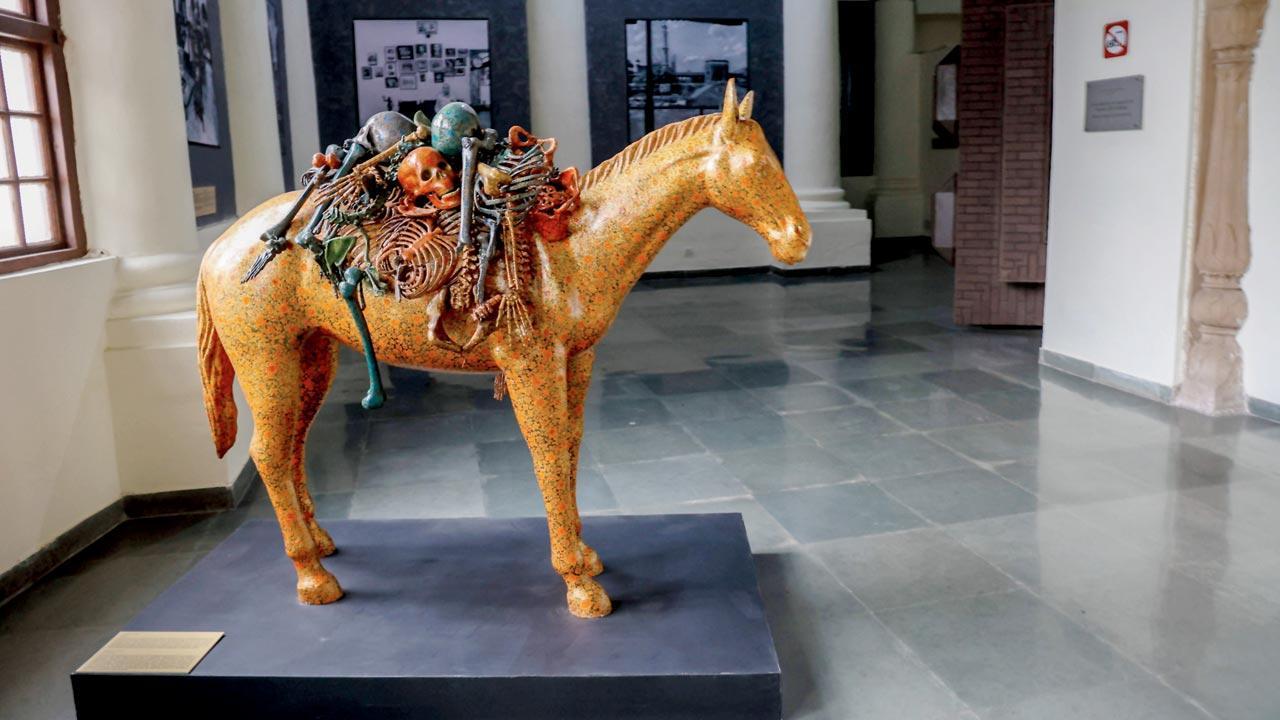
The museum’s lobby-area leading up to the exhibition opens with the Kashmiri papier mache sculpture of a horse carrying a load of skulls and bones by Kashmiri artist Veer Munshi. Pics/Nishad Alam
At a hectic and continuous intersection of history from 17th to 21st century Delhi, facing the Delhi Junction Railway Station, an ancient building inside Ambedkar University is readying for its latest life as a museum. Its first stint was as Mughal prince Dara Shikoh’s library. It will now hold the country’s second Partition Museum dedicated to the 1947 Partition of South Asia into India and (East and West) Pakistan by the British Imperial rule.
“This museum has a strong Delhi focus,” says Kishwar Desai, author and chairperson of The Arts and Cultural Heritage Trust (TACHT) that has founded both museums. The Delhi Partition Museum’s building was given to them by the Union Government’s Adopt A Heritage scheme, and was restored by the Delhi Government. The curatorial team comprises Desai, Mallika Ahluwalia, Ganeev Dhillon, Shreyashi Bagchi and Himanshi Saini.
Trending Stories
Latest Photos
Latest Videos
Latest Web Stories
ADVERTISEMENT
Mid-Day Fast
ADVERTISEMENT

ADVERTISEMENT