






Home / Sunday-mid-day / / Article /
Sam Miller’s latest book on migration seeks to change the contemporary narrative
Updated On: 26 February, 2023 10:54 AM IST | Mumbai | Sucheta Chakraborty
Journalist-author Sam Miller’s book on migration looks at its centrality in human history and aims to reposition modern discussions around it

Listen to this article :
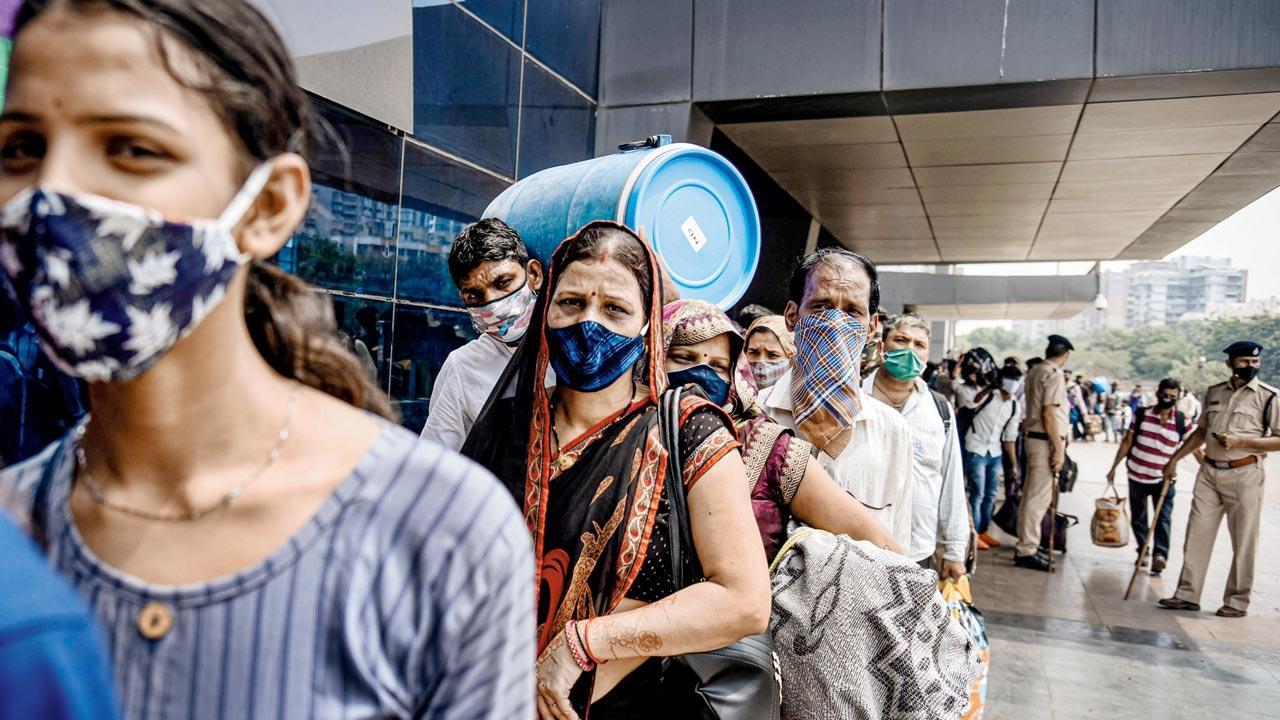
Migrants queue up at a railway station in Mumbai to leave the city ahead of a lockdown to slow the spread of COVID-19 in April, 2021. Pic/Getty Images
One damp October morning in 2018, I spent 25 minutes in my father’s old study spitting into a small plastic tube,” begins a chapter in Sam Miller’s Migrants: The Story of Us All (Abacus, R899), in which Miller, a London-born former BBC journalist and author who has lived and worked in several countries across Africa and Asia, including India, reflects on his lifelong penchant for a nomadic way of life. “[I]t feels elemental, as if a desire to be on the move, to travel to new places, to be with people who are not like me is part of my being,” he contemplates. Curious about his own desire to keep moving and intrigued by the workings of a “curiosity” gene, an ancient genetic mutation known as DRD4-7R present in all human populations, and among some genetic markers scientifically correlated to how far particular groups travelled from Africa in prehistoric migration, he writes about his decision to test his DNA. This rumination forms a part of one of the book’s several ‘intermissions’ —sections where Miller weaves more personal travel stories about expats and the Passport Index with the book’s larger historical narratives of migration. “It’s something I use in all my books, and they enable me to break with the normal constraints of narrative non-fiction. It’s liberating,” he tells mid-day over an email interview. “Here, it enables me to reflect on my own migration experiences, as well as incorporate the stories of others into the narrative.”
The book’s main focus however, is the importance of migration to the human story, a matter that Miller contends has become a modern proxy for other issues affecting our lives and thought such as identity, religion, home, multiculturalism, integration, racism and terrorism. Hence the book, he proclaims, is his attempt “to restore migration to the heart of the human story”, to challenge the way it has been overlooked or misunderstood in history and reposition both the dominant view about migrants and the modern discussions around migration. “It’s a subject that I’ve been interested in for a long time,” he says, his work alongside migrants in different countries over the years having proved influential. “I felt there was very little honest discussion about it in most countries–and very little recognition of how fundamentally migratory we humans are as a species. In the Indian context, it’s a subject that came up in my first book, Delhi: Adventures in a Megacity, and my encounters with Bangladeshi migrants who felt they had to disguise their place of origins, even though they were living alongside—and sometimes married to—migrants who came from West Bengal.”
Trending Stories
Latest Photos
Latest Videos
Latest Web Stories
ADVERTISEMENT
Mid-Day Fast
ADVERTISEMENT

ADVERTISEMENT