






Home / Sunday-mid-day / / Article /
How Mumbai’s street economy survives the heat with chaas, kala chasma and topis
Updated On: 21 May, 2023 11:58 AM IST | Mumbai | Jane Borges
While we complain in air-conditioned offices about the scorching heat, the men and women in the city’s street economy go about their lives aided by chaas, kala chasma and topis

Listen to this article :
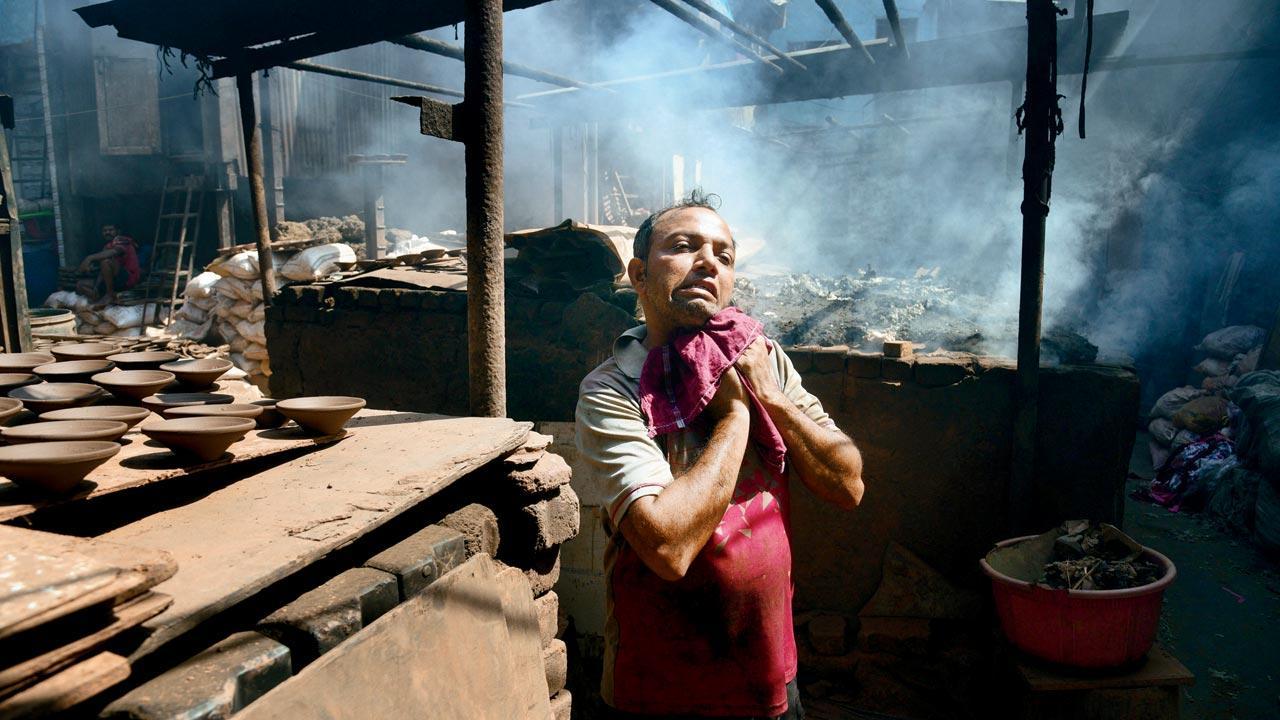
Haresh Shamji Singhadia, a potter from Kumbharwada, Dharavi, says he cannot do without his tea, even though it’s not advisable in the extreme conditions in that he works. Pic/Pradeep Dhivar
At 11.30 am, Sumati Ganesh Dingankar can’t take it anymore. She abandons her basket of fish placed on the corner-side of the footpath, and heads to the nearby juice vendor. There’s a wooden board above her basket, with four pomfret and a pair of boi; a pocket-sized umbrella has been left open next to a tiny stool, where she otherwise sits, calling out to passersby. But, today, the sun is beating down, making it impossible for the 52-year-old fishmonger to work. Those arriving at her makeshift dukaan on a footpath near Shrikant Palekar Marg in Chira Bazaar will have to wait. Dingankar has gone to buy herself a glass of ice-cold watermelon juice. She returns with two of them—one for her fishmonger friend, who is slicing a surmai thinly for a customer.
Dingankar was among the unfortunate few who lost her stall—one that she claims was owned by three generations of her family—when the 150-year-old Chira Bazaar fish market was demolished for Metro 3 construction work. While the 100-odd fishmongers were promised an alternative space and rent, Dingankar’s husband passed away while negotiations were on. She didn’t find place on the rent roll of the Mumbai Metropolitan Region Development Authority. “I lost out on their monthly `10,000 stipend, due to which I can’t rent a space. Now, I am forced to sell fish on the streets,” she tells us. With no shade or roof overhead, selling fish in this apocalyptic heat is agonising.
Read Next Story
Trending Stories
Latest Photos
Latest Videos
Latest Web Stories
ADVERTISEMENT
Mid-Day Fast
ADVERTISEMENT

ADVERTISEMENT