






Home / Sunday-mid-day / / Article /
Fali S Nariman, 1929-2024: Burma’s loss, India’s gain
Updated On: 25 February, 2024 07:30 AM IST | Mumbai | Team SMD
In his riveting autobiography (pray, why wasn’t he a writer), late Fali S Nariman relives an arduous three-week trek from Rangoon to Delhi via Imphal where his family landed as refugees after Japan overran Burma during WWII

Listen to this article :
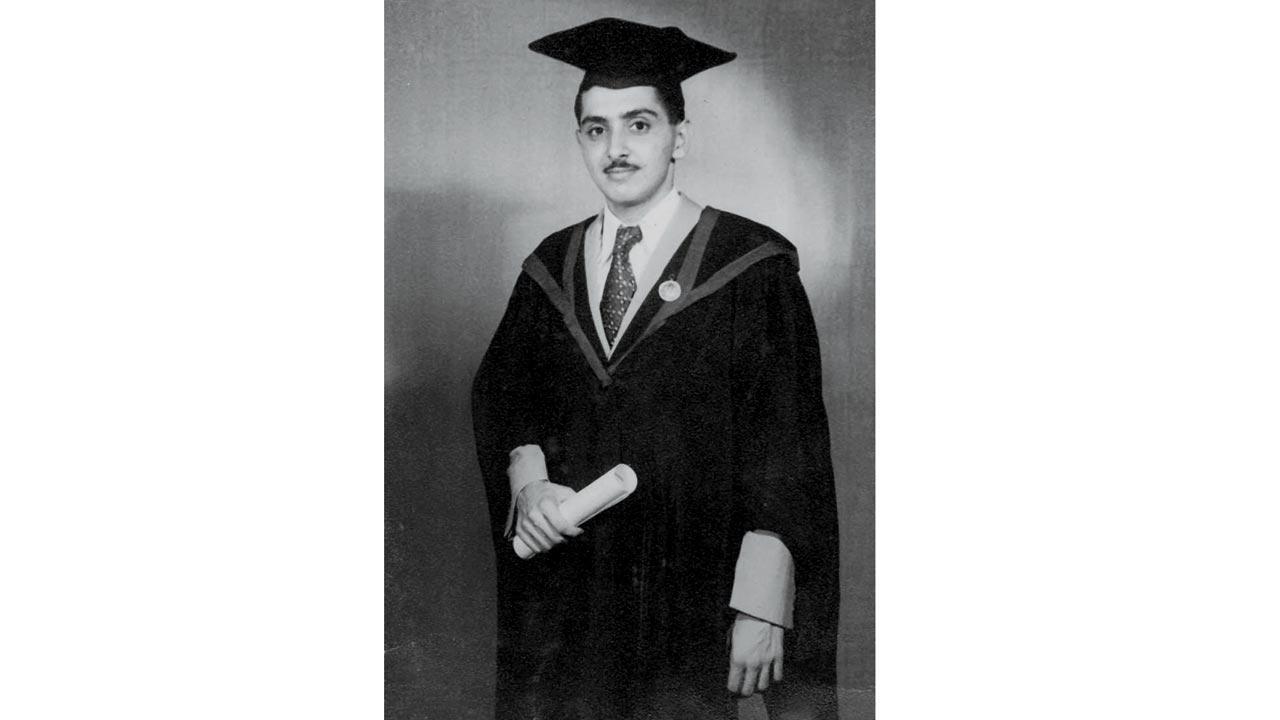
Fali Nariman with his Bachelor of Law degree. Pics Courtesy/Hay House India
I grew up in Rangoon (then capital of Burma) in the 1930s under the loving care of my parents (I was their only child). Spoilt? I am afraid so; I was always ‘Baba’ to my parents. We lived in a rented doubled-storied bungalow (Kennedy House) near the Royal Lakes. I can truthfully describe my childhood as ‘a cloudlessly happy one’. The clouds gathered, but only later when I was 12 years old in December 1941, when the Japanese bombed Rangoon and then invaded and quickly conquered Burma. When I was five, I was thrilled to take part in a children’s programme broadcast over All Burma Radio—it was not a speech or a poem, but a catchy tune called Rendezvous. I did not sing or play it—I whistled it. I believe it was a hit, but I have had no requests since then to whistle catchy tunes! Another early recollection is when I was six years old in standard I of a coeducational school. The principal (an imperious lady, Miss Hardy) announced one morning at assembly that King George V had died. She then added that she had been instructed to declare a holiday, at which there was loud cheering. Miss Hardy promptly revoked the declaration of a holiday, as a result of which the school was fined a substantial sum by the director of education! And we all whispered under our breath: ‘Serves her right’. After a year, I moved on to a regular boy’s school (The Diocesan Boys School) where the principal, LS Boot, was much less impetuous. Progressing from one class to another, a good student but of average ability, I reached standard VII where my class teacher was WW Rollins. And what an excellent teacher he was—his lectures in geography, illustrated with maps prepared by him, have left an indelible impression on me.
Nothing very eventful disturbed the even tenor of our lives in Rangoon–until Japan declared war on the Allied Powers after bombing Pearl Harbour on 7 December 1941. Within a week, the city was targeted by air attacks. We witnessed intense and incessant bombing, and spent more time in our makeshift air-raid shelter in the garden of our home than in our bungalow. Soon we moved north to Mandalay for what we thought would be a brief sojourn. This was on the advice of the then governor of Burma, Colonel Sir Reginald Hugh Dorman-Smith, who confidently told my father at one of his war council meetings: ‘Don’t worry Sam, we will get rid of the Japanese in a month or two.’ My father was taken in by this assurance—how could the chairman of the War Council of Burma be wrong? But he was wrong—hopelessly wrong. Contrary to Dorman-Smith’s expectations, the invasion by the Japanese Army was so swift and fierce that for us the road back to Burma’s capital city was cut off.
Trending Stories
Latest Photos
Latest Videos
Latest Web Stories
ADVERTISEMENT
Mid-Day Fast
ADVERTISEMENT

ADVERTISEMENT