






Home / Sunday-mid-day / / Article /
Sohail Rekhy & Raghujiraje Angre uncover the untold history of Mumbai's Hamptons
Updated On: 31 December, 2023 03:47 AM IST | Mumbai | Mitali Parekh
Two forces—author Sohail Rekhy and historian Raghujiraje Angre—come together to remind us that there is much history to Mumbai’s Hamptons than being a playground of the rich

Listen to this article :
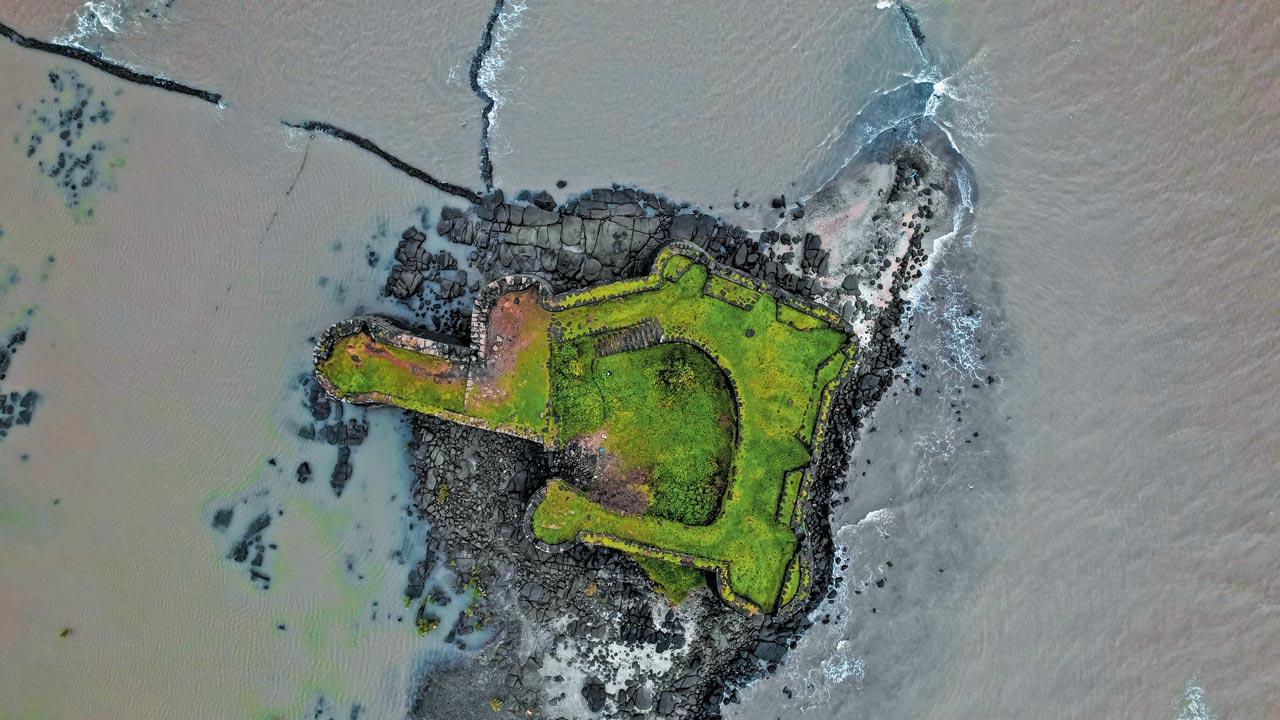
The amphibious Kolaba or Alibaug Fort that’s in water during high tide
We know of him fleetingly in naval circles, through INS Angre, the port that provides logistics and administrative support to the Western Naval Command. Then his son, Sumbhajee Angria, popped up in the Pirates of the Caribbean franchise when Jack Sparrow stole his precious ruby. Maybe he’s a little bit more well-known to students and enthusiasts of Maratha history.
But along the Konkan coast, and most dominantly in Alibaug (though not as much as he should be, we argue), Sarkhel Kanhoji Angre is “Raze”—naval commander of the Maratha army—who fought off the East India Company coming in from Korvai, the Siddhis from Murud Janjira, the Dutch at Vengurle and the Portuguese all around the coast. He was the only adversary against whom the British and Portuguese, joined forces. Such was Kanhoji’s prowess that the GDP of Alibaug state in the years 1680 to 1729 was approximately Rs 36 lakh a year; this at a time when India, China and Iran—all kingdoms with great sea trade—made up 80 per cent of the world’s GDP. To establish sovereignty, he minted the silver Alibaugi rupaiiya, one of which was worth 1.20 British pounds. And yet, until recently corrected, Kanhoji Angre—the first of the House of Angres—was referred to as a maurading pirate in Western literature. A reputation traced to Robert Clive of the East India Company.
Trending Stories
Latest Photos
Latest Videos
Latest Web Stories
ADVERTISEMENT
Mid-Day Fast
ADVERTISEMENT

ADVERTISEMENT