






What is Ravana’s surname?
Updated On: 14 January, 2024 06:56 AM IST | Mumbai | Devdutt Pattanaik
This is why the monkeys refuse to travel by boat to Lanka, but insist on building a bridge.

Listen to this article :
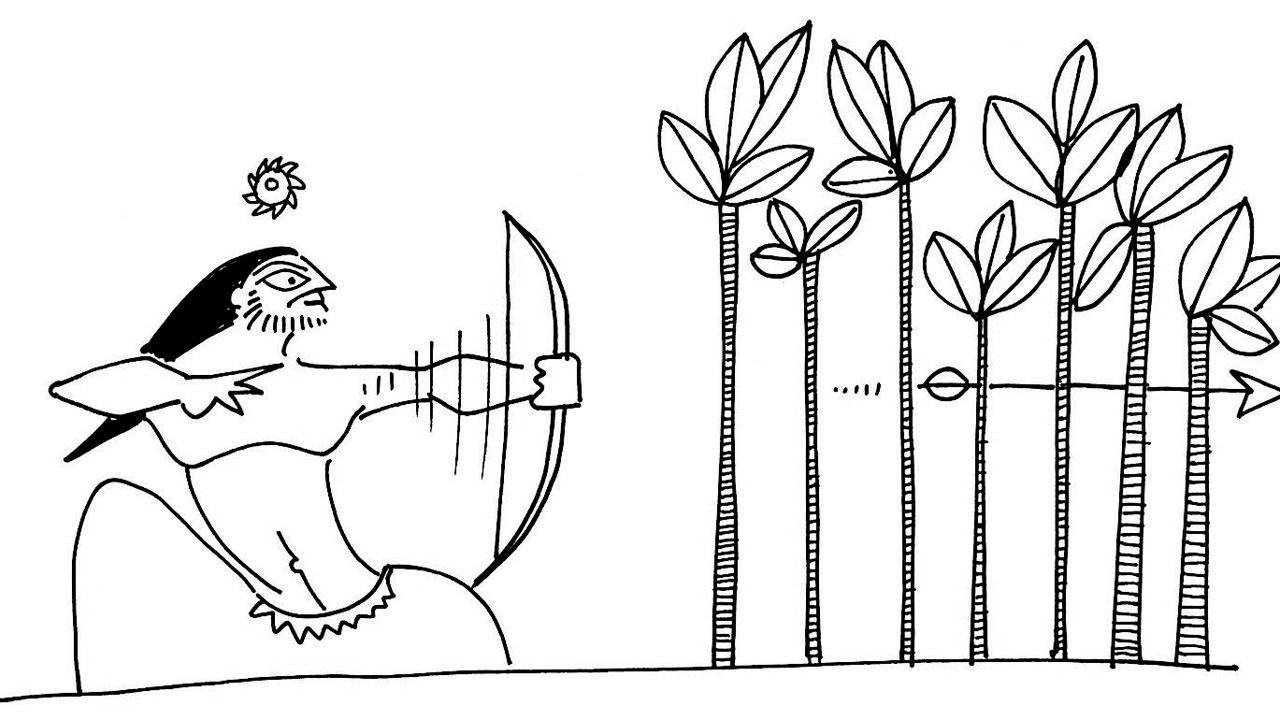
Illustration/Devdutt Pattanaik
 In the Uttar Ramayana, we hear of Ravana’s genealogy. From his father’s side, he is Vaishravana (son of Vishrava) and Paulatsya (descendant of Pulatsya). He shares these paternal surnames with Kubera, his half-brother, who he displaces as king of Lanka. His mother is Kaikesi, daughter of Sumali, whose surname is Salakatantaka, resident of the dense Sal forests.
This is very significant, because the Sal tree grows in Jharkhand, Chhattisgarh and Odisha but not in Sri Lanka. Scholars have been clear that early Ramayana texts refer to a geography that does not go south of the Vindhyas or Narmada, as is popularly believed. When Sugriva describes the geography of India, he states that Kishkinda is to the north of Narmada and Vindhya, east of Mahanadi. In the oldest manuscript, Ramayana’s geography stretches between the Ganga river plains and the dense Sal forests to its south. The ocean was probably a vast water body (dug by the sons of Sagara) filled with crocodiles that monkeys fear the most. This is why the monkeys refuse to travel by boat to Lanka, but insist on building a bridge.
Read Next Story
Trending Stories
Latest Photos
Latest Videos
Latest Web Stories
ADVERTISEMENT
Mid-Day Fast
ADVERTISEMENT

ADVERTISEMENT