






Pushpak Viman was a wooden peacock
Updated On: 21 January, 2024 04:53 AM IST | Mumbai | Devdutt Pattanaik
On this flying vehicle, the carpenter’s son not only went to school, impressing his class, but also on many adventures, eventually marrying a princess.

Listen to this article :
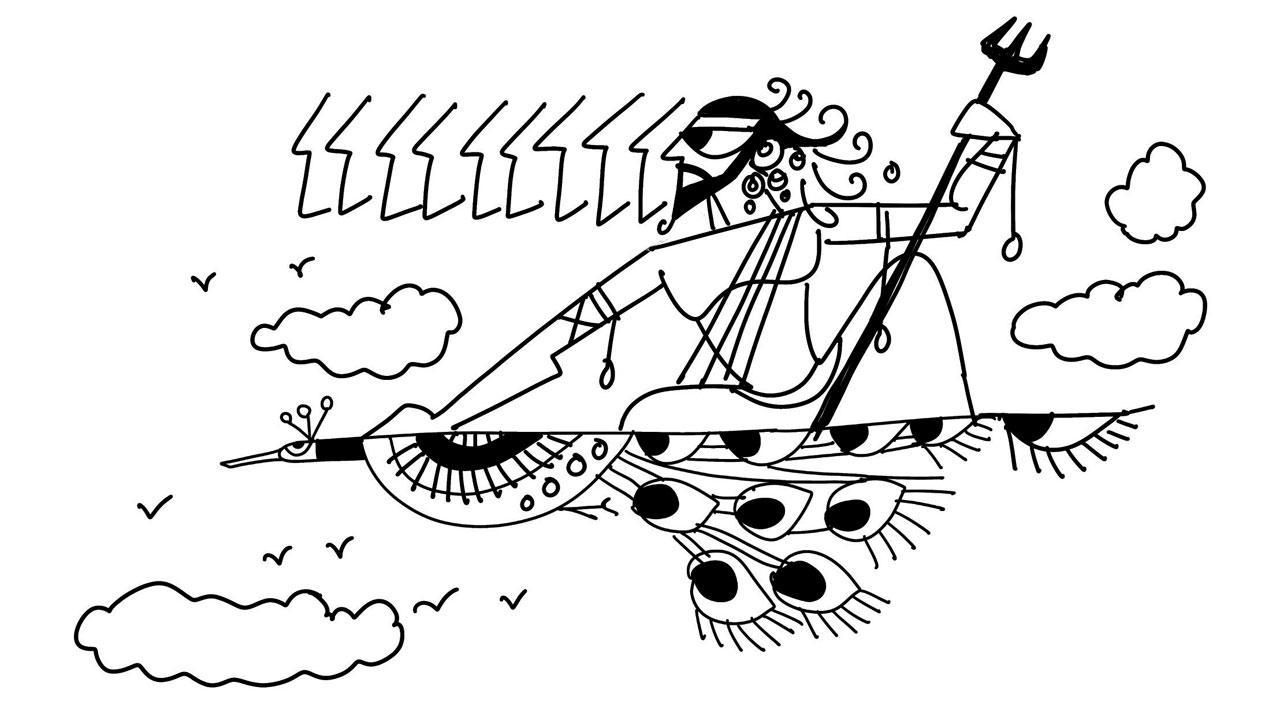
Illustration/Devdutt Pattanaik
 Pushpak Viman of Ravana was shaped like a peacock. The origin of this idea comes from an old Sri Lankan folk tale. Since a headman gave his son a horse-drawn cart to go to school, a carpenter’s son pestered his father for a vehicle. His father created a wooden peacock (dandu-monara, in Sinhalese), fuelled with mercury, that could fly. On this flying vehicle, the carpenter’s son not only went to school, impressing his class, but also on many adventures, eventually marrying a princess.
Nowadays, in hotels and bars around Colombo, Sri Lanka, one finds images of this flying wooden peacock, but it is not described as a creation of a carpenter. It is described as Ravana’s Pushpaka Vimana. In a recent conference, it was argued that Ravana invented the aeroplane long before the Wright brothers. As in India, mytho-fiction writers are arguing that Ravana was a great king of ancient Sri Lankan—an expert in medicine, engineering, martial arts—whose history has been deliberately erased by later Buddhist chronicles introduced by Indians. The older “Hala-Yakha” civilisation was full of wonderful technologies. In 2019, Sri Lanka launched its first satellite. It was named Raavana 1.
Read Next Story
Trending Stories
Latest Photos
Latest Videos
Latest Web Stories
ADVERTISEMENT
Mid-Day Fast
ADVERTISEMENT

ADVERTISEMENT