






Pot of gold at the end of the rainbow
Updated On: 12 November, 2023 04:26 AM IST | Mumbai | Shweta Shiware
A unique exhibition of historic jewel-toned paithanis, hosted in the Marathi textile’s very home, explores its cultural history and ancient India’s love for gold thread

Listen to this article :
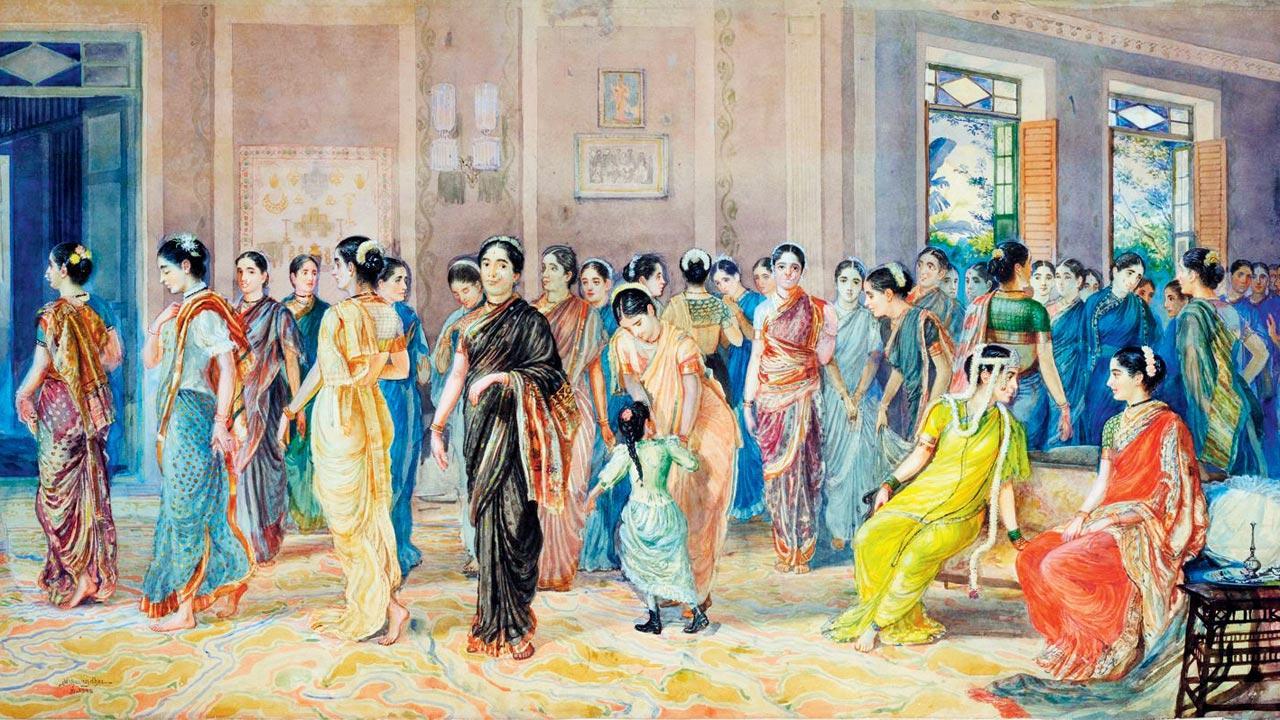
A watercolour by RMV Dhurandhar (1867-1944) called Scene of a Hindu Marriage Ceremony; collection of Sangli Museum, Sangli; reproduction of original, courtesy The Directorate of Archaeology & Museums, Government of Maharashtra
 RMV Dhurandhar’s Scene of a Hindu Marriage Ceremony (1867-1944) is a mesmerising watercolour that depicts well-to-do anonymous female kinship, chronicling Marathi women in rich katha-padarachi sarees in jewel tones. Somewhere in the middle of the canvas, two friends hold hands. The artist proffers it to the viewers as though we are expected to see it.
It is enough to make you curious. The eye moves next to the young bride dressed in a yellow nauvari (nine yard), her wrists decked in green and red bangles, her head haloed in a traditional floral headband. She leans into a female confidant. While so many of the 18th to early 20th century elite marriage ceremony portraits are rigidly formal—a historic record of a contract—this one is conversational and sensuous. The whole painting seems to sway. And the crowning glory of this poetic chiaroscuro composition, with ample hints of gilt, are the RGB coloured paithani sarees they wear. The ornamental borders (kath in Marathi) end in peculiarly short padars (pallu) on their shoulders. “This is a ritualistic gathering where only women are permitted. So, we don’t know whether Dhurandhar was commissioned [to make the artwork] or he drew it over a period of time from different references. But we can safely say that this is a fantastic representation of what a roomful of women wearing paithanis looked like,” curator Mayank Mansingh Kaul tells mid-day at the opening of Kāth Padar-Paithani & Beyond at Shri Balasaheb Patil Government Museum in Paithan recently.
Read Next Story
Trending Stories
Latest Photos
Latest Videos
Latest Web Stories
ADVERTISEMENT
Mid-Day Fast
ADVERTISEMENT

ADVERTISEMENT