






Mrinal Sen: ‘Eccentric, irresponsible adult’
Updated On: 15 October, 2023 07:19 AM IST | Mumbai | Meenakshi Shedde
Mrinal Sen has a body of about 34 films; many were acclaimed at the Cannes, Berlin and Venice film festivals, and worldwide

Listen to this article :
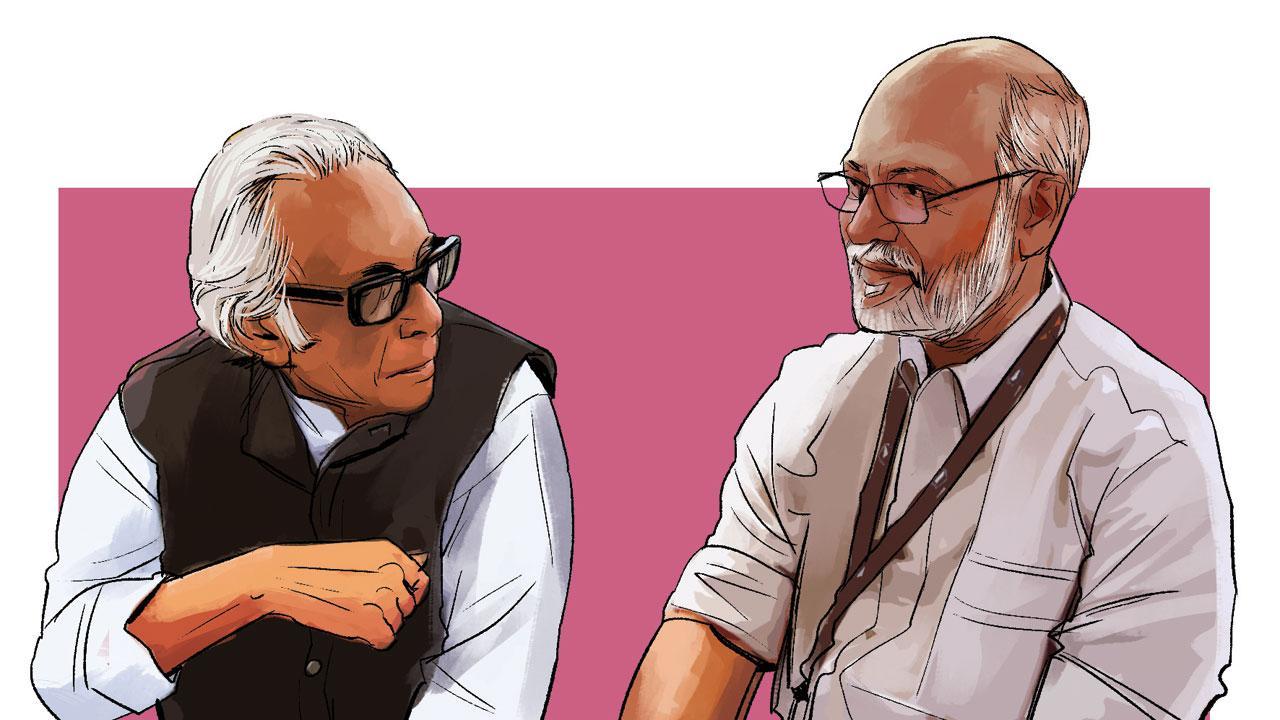
Illustration/Uday Mohite
 Kunal Sen’s book Bondhu, on his father, the late, distinguished filmmaker Mrinal Sen (May 14, 1923-December 30, 2018, whom, wonderfully, he calls Bondhu, friend, rather than Baba, father), is punctuated with a refreshing honesty and candour that are not the hallmarks of books on celebrities in your family. These often wallow in hagiography, but Kunal Sen’s Bondhu is a marvellous and frank tribute, celebrating Mrinal Sen’s birth centenary year. “As I was growing up, Bondhu did not play the traditional role of a father… I found him a slightly eccentric, somewhat unreliable, irresponsible and bumbling adult,” he writes in Bondhu (Seagull Books, paperback Rs 599). He recalls a wrenching incident he heard from his mother, the accomplished actress Gita Sen. When his parents married, they did not have anything substantial to eat for a couple of days. Sen promised to borrow some money, buy rice and return immediately. His mother put a handi of water to boil to cook the rice, and waited endlessly. His friend Nripen came by to ask if Mrinal-da was home, as he had been chatting with him and other friends in the neighbourhood. Later, his mother burst into tears. When Mrinal-da returned, she told him Nripen was looking for him. “My father exploded: ‘Shala!’ Bastard. My mother poured water over the burning coals, put out the fire and went to bed… I hated my father’s selfishness. But looking back with the knowledge of his eventual success, one can lionise his passion and see how that adda in the park with his friends was more important to him than the hunger,” Kunal Sen writes.
Mrinal Sen has a body of about 34 films; many were acclaimed at the Cannes, Berlin and Venice film festivals, and worldwide. Part of the ‘Bengal Trinity’ of Satyajit Ray, Ritwik Ghatak and Mrinal Sen, the latter two were often overshadowed by Ray, and though a lot of Sen’s work is remarkable, he has not always got his due. A pioneer of the Indian new wave, starting with his Bhuvan Shome (Mr Shome, 1969), his films, often deeply political, include Akaler Sandhane (In Search of Famine, 1981), Kharij (The Case is Closed, 1982), Khandhar (Ruins, 1984), Ek Din Pratidin (And Quiet Rolls the Dawn, 1979), and his famous Calcutta trilogy, Interview (1971), Calcutta ’71 (1972) and Padatik (The Guerrilla Fighter, 1973).
Read Next Story
Trending Stories
Latest Photos
Latest Videos
Latest Web Stories
ADVERTISEMENT
Mid-Day Fast
ADVERTISEMENT

ADVERTISEMENT