






AQI kya hai
Updated On: 05 November, 2023 04:41 AM IST | Mumbai | Paromita Vohra
That is correct, because the best things in life are free, mera matlab hai green.

Listen to this article :
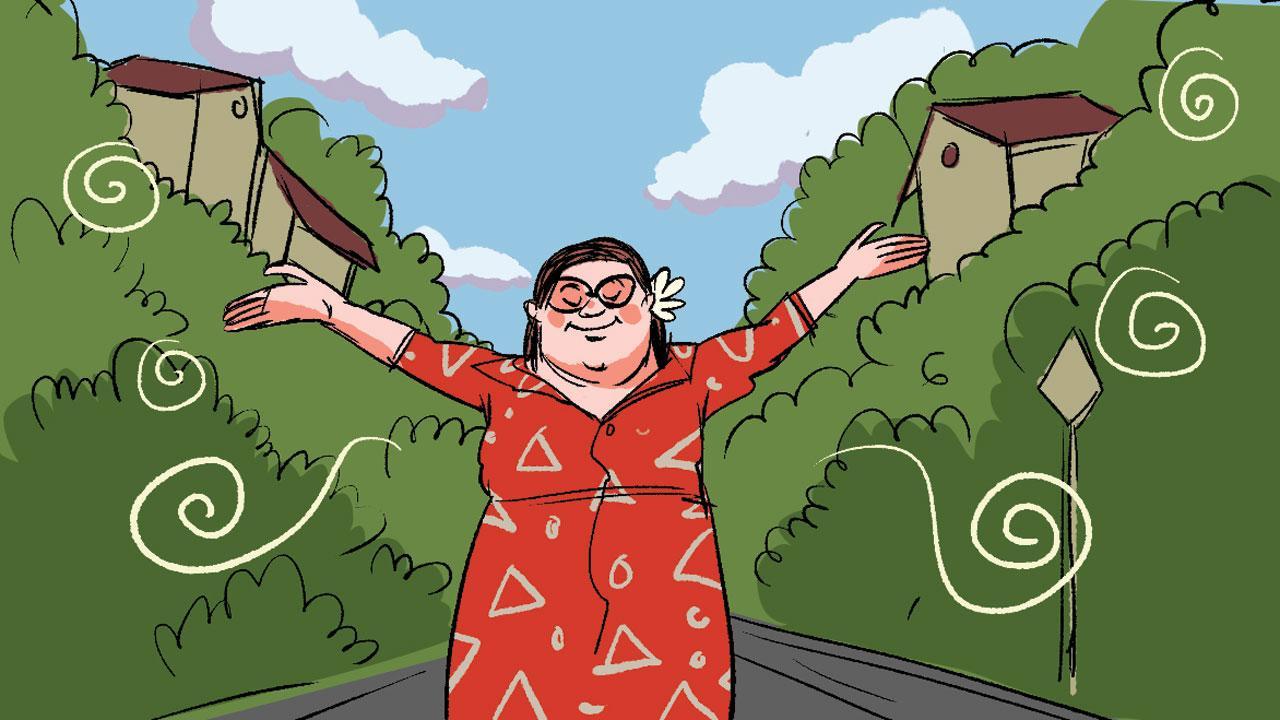
Illustration/Uday Mohite
 I’ve spent the last few days in the middle of an expanse of green. Don’t get me wrong, it’s not a sylvan forest or pastoral paradise. It’s just a place not yet very developed, as they say. Desires of development are ever around us, however—walls, roads, gates, several barricades. I’m in the area’s sole tall building. From my room on the 7th floor I can see spread out around me, trees and the occasional red roof. As a city-dweller I feel a bit confused. I feel like I must immediately make use of this opportunity and go on several walks, take early morning deep breaths and allow the mists to swirl my brain into softness. Overwhelmed by the need to optimise, I become paralysed and have spent most of my time doom-scrolling, occasionally glancing out at the greenery from my window. Supermarket syndrome it’s called.
And why not supermarket syndrome? After all, greenery has become something to buy. The term greenery, one most often used for crafted greens of gardens, itself sounds like an element of set direction, a moveable piece. Our relationship with greenery is rocky. We have been trained to see it as exotic, found in the forests of Wayanad, or, atop the monsoon Konkan hillsides. Greenery is to be remarked on when encountered. Lying casually around as it is over here, it’s described from human point of view as “that far-flung, deserted place”. How to make it near from far? Build, construct, develop. It’s a compromise relationship of course, but aren’t relationships about compromise—by somebody? A suburb is so near, yet always so far, like so much else in our lives of connected dis-connection.
Read Next Story
Trending Stories
Latest Photos
Latest Videos
Latest Web Stories
ADVERTISEMENT
Mid-Day Fast
ADVERTISEMENT

ADVERTISEMENT