






Home / News / India News / Article /
Lok Sabha elections | 39/40: What about the one?
Updated On: 26 April, 2024 07:35 AM IST | Kishanganj | Mayank Shekhar
Mofussil town, Kishanganj, in Bihar, kept NDA from scoring cent per cent in Bihar in 2019 elections. The reason is somewhat obvious

Listen to this article :
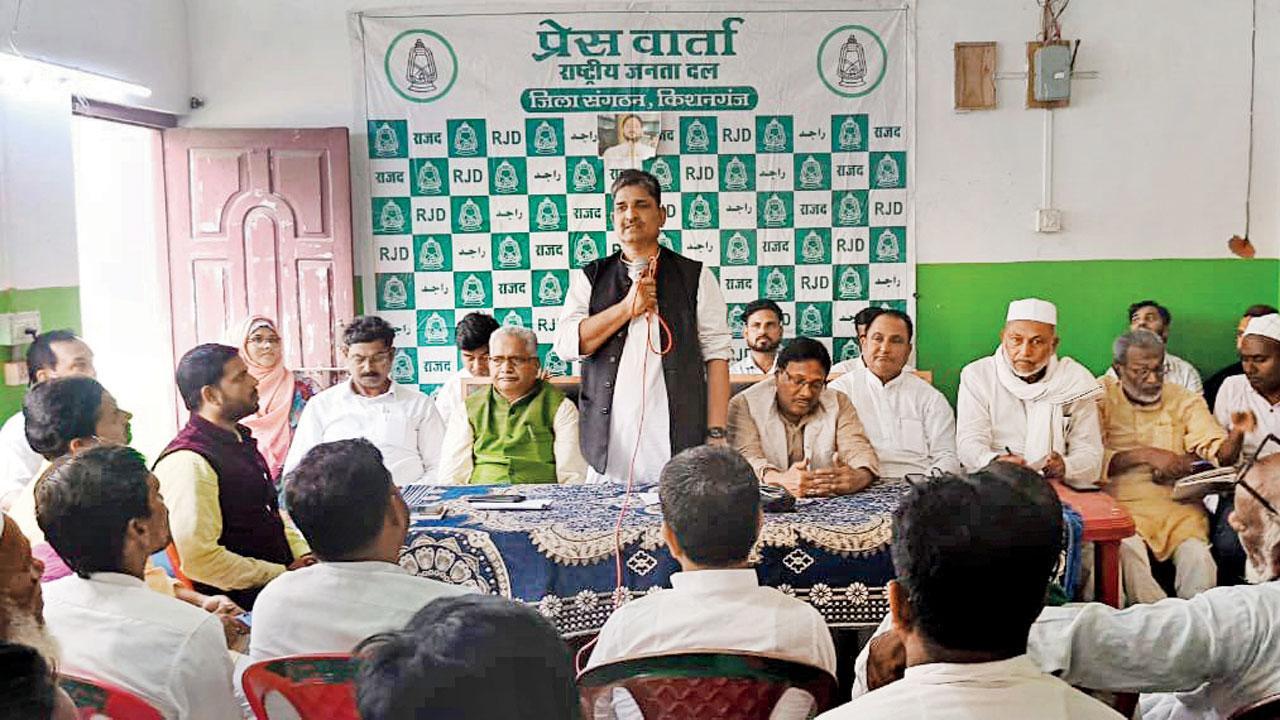
Congress’s Mohammed Dr Jawed (standing) is seeking re-election from the Muslim-majority constituency
The best way to tell that you’ve crossed the border from Bengal to Bihar, driving down Siliguri’s Bagdogra airport—even without looking for the toll booth—is to casually study flags that line the highway, shops, constructions, all across. Simple vexillology, as it were. At some point, quite simply, the saffron-green of the BJP’s lotus, and obviously the tricolour with Trinamool Congress’s election symbol, simply recede to a zero. But for a few BJP flags, and fewer INC’s “haath chhaap” tricolour still.
You know you’re in Bihar, specifically Kishanganj. What unites with Bengal, though, are the triangular ‘bhagwa dwaj’ (saffron flags)—with Lord Ram, or Hanuman, as with Chhatrapati Shivaji in rural Maharashtra—flying, throughout. The name Kishanganj is so generic, like the district itself, that a colleague in Mumbai told us they’d heard of it. Surely, in a Bollywood movie—to denote a typical small town/village, like Ramgarh in Sholay! That said, Kishanganj also remains among the most backward districts in India, and Bihar, at any rate, which is already the most backward among states. What’s so special?
Trending Stories
Latest Photos
Latest Videos
Latest Web Stories
ADVERTISEMENT
Mid-Day Fast
ADVERTISEMENT

ADVERTISEMENT