






Home / Mumbai / Mumbai News / Article /
Kavach tech wouldn’t have averted Odisha disaster
Updated On: 05 June, 2023 07:31 AM IST | Mumbai | Rajendra B. Aklekar
Diversion of passenger train to loop line meant that there was no time for anti-collision technology to have deployed as passenger train decelerated from 128 kmph to zero in a matter of seconds on hitting iron ore-laden freighter

Listen to this article :
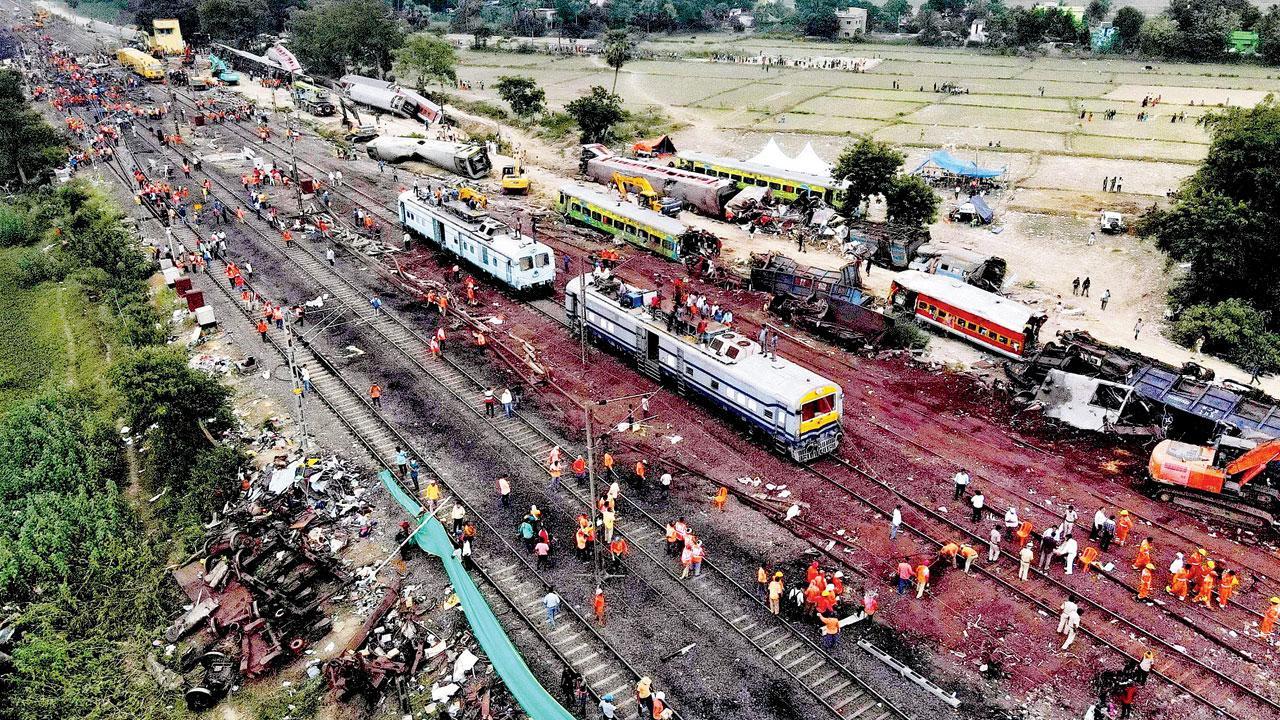
Restoration work at the site of Friday’s triple train accident near Bahanaga Bazar railway station, in Balasore district, Odisha, on Sunday. Pic/PTI
Government officials have claimed that Kavach—an anti-collision device being developed since 2012 and rolled out last year—would not have prevented the loss of 275 lives in the Odisha train accident. A retired railway official also believes the technology wouldn’t have stopped the tragedy, as the Express train had a signal for the main line. The goods train, with which it collided, was standing on the adjacent track.
The government said on Sunday that Coromandel Express, which was coming at a speed of 128 kmph, moved the loop line due to a last-minute diversion and rammed into a goods train laden with iron ore. While the heavy freighter absorbed did not move an inch, Coromandel Express bore all the burnt and derailed. The train came to a halt in a matter of just 23 seconds, according to records.
Read Next Story
Trending Stories
Latest Photos
Latest Videos
Latest Web Stories
ADVERTISEMENT
Mid-Day Fast
ADVERTISEMENT

ADVERTISEMENT