






Home / Mumbai / Mumbai News / Article /
Jo utra so doob gaya...
Updated On: 09 October, 2022 08:06 AM IST | Mumbai | Yusra Husain
Amir Khusrau’s poem seems to have struck Khusrau festival founder and filmmaker Muzaffar Ali, quite literally, when his life’s work was damaged by Gurugram’s September floods

Listen to this article :
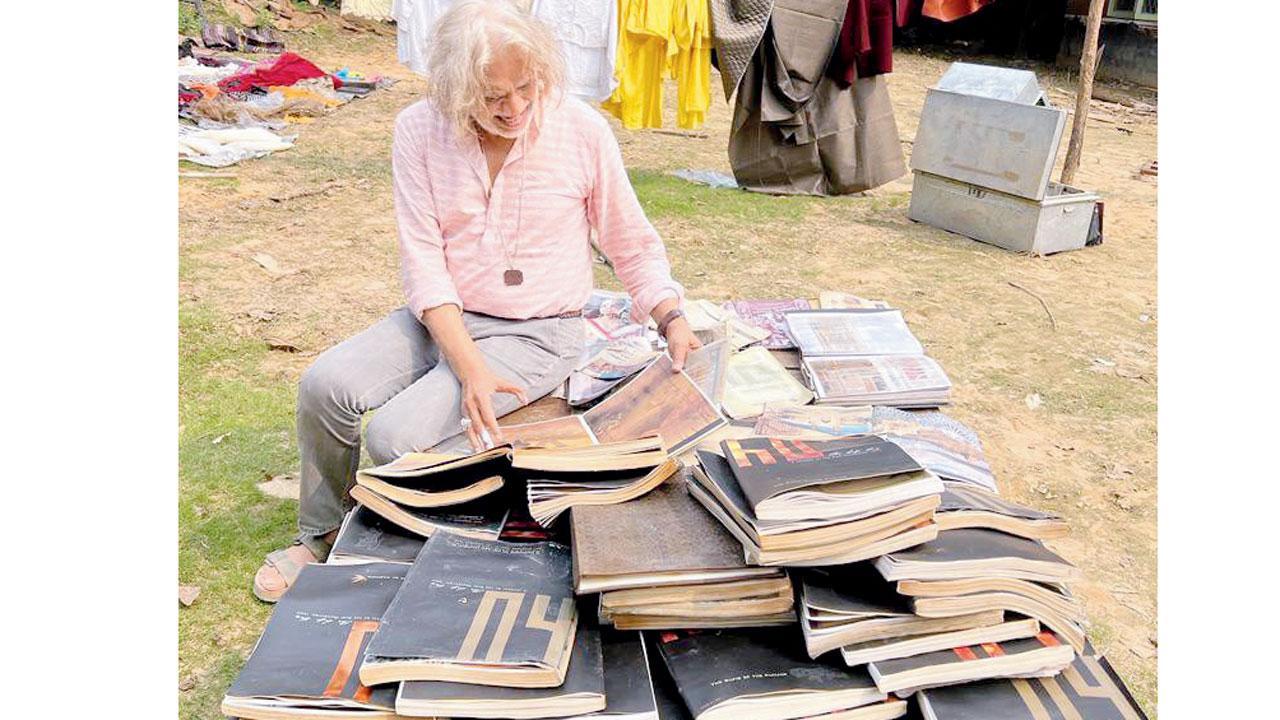
Muzaffar Ali and wife Meera have been sunning the archival music, costumes, journals and documents from Ali’s films and Jahan-e-Khusrau festival at their Gurugram home, which got flooded in September
Arab ki Sarai at Delhi’s Humayun’s tomb was immaculately dressed up for the Jahan-e-Khusrau, an annual three-day Sufi music festival held to commemorate the death anniversary of Amir Khusrau. The year was 2001. Illustrious artistes joined the magnificent musical company of Pakistan’s Abida Parveen, Iran’s Rumi Group and Tunisia’s Lotfi Bouchnak, to regale an audience that sat in the open gardens under moonlight. Little did festival founder, filmmaker and Padma Shri awardee Muzaffar Ali know that 20 years later, just under 25 km away from this venue, a lifetime worth of work would see a “pani phir gaya” moment.
Kotwara Farm, Ali’s home in Gurugram’s Gwalpahari, sits in a nasheb (Urdu for slope) as he puts it, with the beautifully rugged Aravali mountain range in close proximity and a pond behind the residence. This beauty, Ali realised, now comes at a price since the area has seen a burgeoning urban township spring up. Ali says much of it has to do with ASF Infrastructure, a private firm, developing an Information Technology sector-specific Special Economic Zone (SEZ) in the area. “There are high-rise buildings here now. Water from the pond and the storm water drainage that passes right next to our house, is blocked by new construction and the hillock made by TERI [The Energy and Resources Institute] in the name of a golf course,” Ali alleges.
Trending Stories
Latest Photos
Latest Videos
Latest Web Stories
ADVERTISEMENT
Mid-Day Fast
ADVERTISEMENT

ADVERTISEMENT