






Home / Mumbai / Mumbai News / Article /
8,000 citizens stuck in Sion transit homes for three decades
Updated On: 02 February, 2014 07:28 AM IST | | Varun Singh
<p>35 years after they were asked to move into tiny transit homes in Sion's Prateeksha Nagar, over 8,000 men, women and children continue to remain there, with MHADA failing to relocate them</p>

Listen to this article :
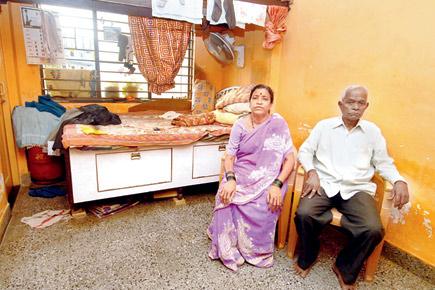
Laxman Shinde, Aaba Keluskar, Chitralekha Bagkar
Aaba Keluskar is 65. The Maharashtra Housing and Area Development Authority (MHADA) forced his family to shift to a transit home in Prateeksha Nagar back in 1979. He was 30 then and was told that in a few years, he and his family would be back in Mazgaon where their original house was being repaired. Chitralekha Bagkar was 17 when she came to the same transit camp in 1976. Sindhu More and Laxman Shinde moved here in 1979. Today over three decades later, 8000-odd residents of these transit homes in Sion’s Prateeksha Nagar are still waiting for their promised land.

Laxman Shinde came to the transit home at Prateeksha Nagar with his brother and wife in 1979. He lived at Kalabadevi but moved here after his building collapsed. Shinde says he has forgotten what his home looked like. Pics/Sameer Markande
According to a local leader and former member of MHADA’s Mumbai board, Allwyn Dias, who also resides in Prateeksha Nagar, the situation is terrible here as many residents are suffering from depression, having almost given up hope of getting their homes back again.
What is a transit camp?
There are more than 17,000 buildings in Mumbai’s island city, which are cessed. This means, a certain amount of tax is paid by the residents of these buildings to MHADA for the upkeep of the building. These are old and dilapidated structures and so, whenever any of these buildings are declared dangerous, the residents are moved out and given transit accommodation. The transit accommodations are officially short-term accommodation so that residents of these buildings have a decent roof over their head till their old buildings are repaired or rebuilt. However, in several cases in the past two decades, the buildings haven’t been reconstructed. In some cases, the land has been sold to third parties. In effect, the evicted residents become permanently in transit.
Read Next Story
Trending Stories
Latest Photos
Latest Videos
Latest Web Stories
ADVERTISEMENT
Mid-Day Fast
ADVERTISEMENT

ADVERTISEMENT