






Home / Entertainment / Bollywood News / Article /
Dinesh Raheja on Dilip Kumar: His counsellor advised him to do comedies
Updated On: 11 July, 2021 08:19 AM IST | Mumbai | The Hitlist Team
Author, scriptwriter and film historian Dinesh Raheja remembers the legend who revelled in his prolonged silences but was great at humour

Listen to this article :
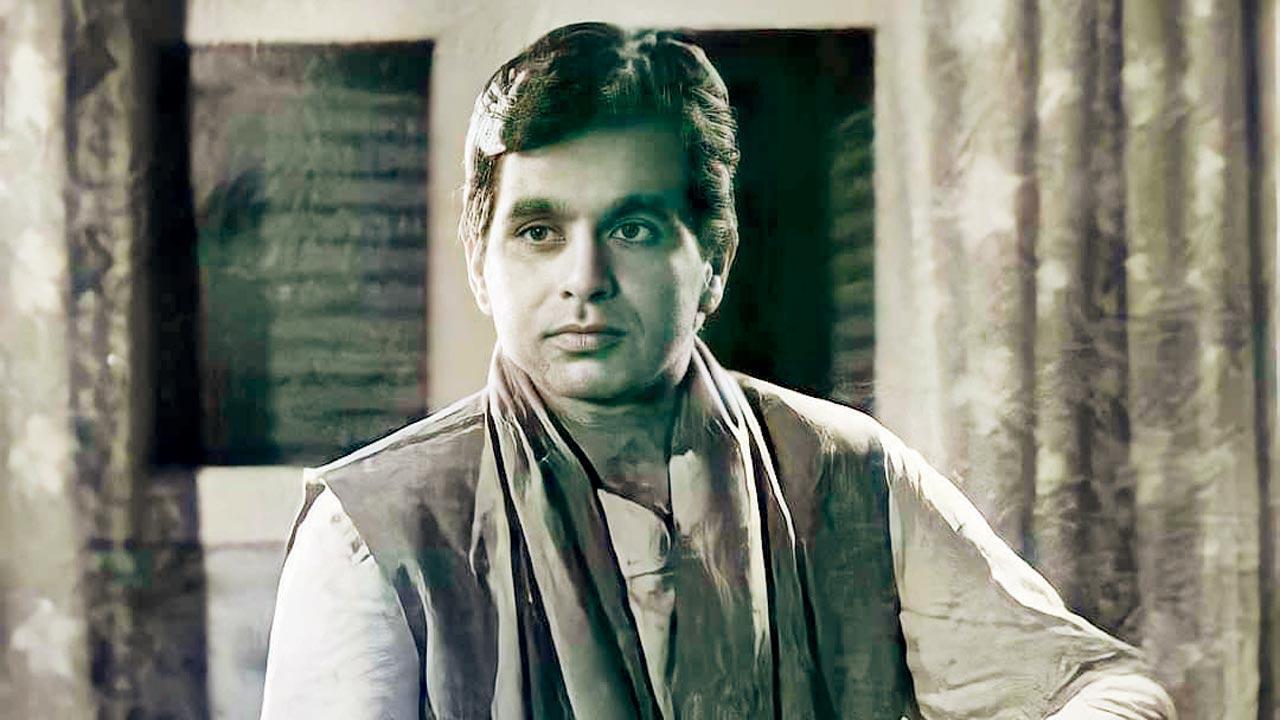
Dilip Kumar. Pic/Vickky Idnaani
 I came of cinematic age in the Rajesh Khanna-Amitabh Bachchan era, so I discovered Dilip Kumar tad late. During the glorious six-month vacation between my ISC exams and college, my schedule would span street cricket, long, lazy lunches and morning matinee shows, which were my personal initiation into cinema literacy and the golden era of black-and-silver. Many of the films I devoured were Kumar’s classics like Andaz (1949), Deedar (1951), Amar (1954), and Madhumati (1958). Even my hipster teen self was impressed by the eloquence of the actor’s silences—whether as the star-crossed Prince Salim of Mughal-e-Azam (1960) or in the titular role of the lovelorn Devdas (1955). He may have been dubbed the Tragedy King, but I went on to discover that his comic timing was also impeccable—Aan (1952), Azaad (1955), Kohinoor (1960), Ram Aur Shyam (1967) and in Bairaag, where he played a triple role with Saira Banu, Leena Chandavarkar and Helen as his three heroines.
The legend surrounding Kumar is enormously powerful and straddles generations. There are few actors with an oeuvre as impressive, and a personality as distinctive. So in the mid-’80s, when the editor of the film magazine I worked for, asked me if I would like to interview Kumar, I let out an enthusiastic whoop! Much before the appointed hour, I was at the Pali Hill bungalow owned by the actor’s star wife, Saira Banu. I was ushered into a huge living room in which I waited patiently. A man’s voice jovially humming snatches of a song from Ram Aur Shyam heralded the arrival of Kumar in a starched white shirt. His pace was leisurely, his smile broad. After exchanging pleasantries, he invited me for a cup of tea in the bungalow’s lush, sprawling lawn. But, the moment I drew out my dictaphone, the famous on screen mumbler—his characteristic style of dialogue delivery though you had to strain your ears to hear him—grew tight-lipped. The interview, which took place in spurts, was interspersed with Kumar asking me to enjoy the silence and listen to the chirping of the birds. Here was an actor who was definitely unique. The rare insight I obtained from the interview was Kumar telling me that at his school, the compositions they were asked to write were not the ‘my summer holiday’ variety. After a prolonged, nail-biting silence, he told me, “We were asked to write a composition on what the bumble bee told the flower.” To date, I am not sure if Kumar was pulling my leg or was dead serious, but I recall that he said it with a straight face.
Trending Stories
Latest Photos
Latest Videos
Latest Web Stories
ADVERTISEMENT
Mid-Day Fast
ADVERTISEMENT

ADVERTISEMENT